
For most mix-and-match offers, two or three gift box size tiers are enough: a small box, a standard gift and, if your stock can carry it, a large one. Space the tiers far enough apart that each has a clear job, and price them so the per-item price falls as the box grows while every size still clears its own worst-case cost.
This guide covers how to choose the number of sizes, how to space them (3 vs 6 vs 9 items is the usual question) and how to price the ladder. It builds on how to calculate the highest allowed cost of a mix-and-match gift box. All prices and costs below are fictional examples for the arithmetic, not recommendations or results from any store.
tnova: Build Your Own Box is a Shopify app for fixed-price, shopper-picked gift boxes. It is currently in Shopify App Store review, so public installation is not available yet.
How gift box size tiers work in a fixed-price box
In a fixed-price box, each size is its own offer: one item count, one candidate pool, one price. A "Box of 3" and a "Box of 6" are two separate boxes, not one box whose price changes with the number of items picked.
That matters for setup in tnova. A box holds 2–12 item units, so you can build a 3, 6 and 9 item ladder (or 4, 8 and 12). Tiered prices inside a single box are outside the current scope, so you create each size as its own fixed-price box. The store limit is 20 unarchived box configurations, drafts included, so a three-size ladder uses three of them. The scope is listed on the tnova features page.
Separate boxes also make the shopper decision simple: pick a size, see one price, fill it.
How many gift box sizes to offer
More sizes do not automatically mean more sales. Every extra tier adds a product page, packaging to source, stock to forecast and a cart path to test. Use this table to decide.
| Number of sizes | When it fits | What it costs you |
|---|---|---|
| One | First seasonal box, small candidate pool, limited packing time | Shoppers who want a smaller or bigger gift have no option |
| Two | You have a clear "treat" price and a clear "proper gift" price | One extra packaging format and one more test path |
| Three | Deep enough stock and pool to fill the largest box with real choice | Three packaging formats; forecasts overlap on the same components |
| Four or more | Rarely worth it for a seasonal launch | Tiers start to blur; more boxes to pause or retire after the season |
A practical rule: add a size only when you can name who buys it and what it replaces. "Stocking filler", "thank-you gift for a host" and "main family gift" are three different jobs. "Six items" and "seven items" are not.
If this is your first season with a shopper-picked box, launch with one or two sizes, watch which one sells, and add the third next season.
How to space the tiers: 3 vs 6 vs 9
Spacing matters more than the exact numbers. Tiers that are too close make shoppers stall between them; tiers that are too far apart leave a gap in price.
Double or triple the count. 3, 6 and 9 or 4, 8 and 12 are easy to read and easy to pack, because each step adds the same number of items. A ladder such as 5, 6 and 8 looks arbitrary and invites "why is 6 a different price from 5".
Check the largest tier against your candidate pool. A 9-item box with a repeat limit of 1 needs at least 9 available candidates, and more if some may sell out. If the pool is 10 variants, a 9-item box offers very little real choice. Either raise the per-variant limit or keep the top tier smaller.
Check shopper effort. Picking 3 items is quick. Picking 9 or 12 on a phone takes longer, so the largest tier needs clear grouping and well-labelled variants.
Check packaging per tier. Each size needs its own insert or box format. Test the worst-case bulky selection in each one. Do not assume a 9-item selection fits because a 6-item one did.
How to price a gift box pricing ladder
Price each size from its own worst-case cost first, then shape the ladder. Shopify lets you record cost per item alongside a product's price; see Shopify's product pricing documentation. Use those costs as the input.
- Find the worst-case item cost for each tier. Take the most expensive legal selection given your repeat limits, not the average.
- Add packaging and packing cost for that tier. Larger boxes usually need a different box, insert and more packing time.
- Set a minimum price per tier that leaves the margin you need on that worst case, before shipping, taxes, payment fees and discounts.
- Shape the ladder. Make the per-item price drop as the box grows, so the bigger box reads as better value, but never below the tier's minimum.
- Round and compare. Use clean prices and check that the gap between tiers is large enough that each size feels distinct.
Worked example (fictional numbers)
Assume candidate items cost the store between $3.00 and $5.50 each, and the repeat limits allow a box filled entirely with $5.50 items.
| Tier | Worst-case items | Packaging | Worst-case total cost | Box price | Price per item | Worst-case margin |
|---|---|---|---|---|---|---|
| Box of 3 | 3 × $5.50 = $16.50 | $2.50 | $19.00 | $34 | $11.33 | 44.1% |
| Box of 6 | 6 × $5.50 = $33.00 | $3.50 | $36.50 | $59 | $9.83 | 38.1% |
| Box of 9 | 9 × $5.50 = $49.50 | $4.50 | $54.00 | $82 | $9.11 | 34.1% |
Margin here is (box price − worst-case total cost) ÷ box price. The per-item price falls from $11.33 to $9.11, so the larger box is better value for the shopper, while the store keeps a positive worst-case margin in every tier. Your real numbers will differ; the method is what carries over.
What to look for in your own table:
- A tier with a much thinner margin than the others. Usually the top tier. Fix it by raising its price, removing the most expensive candidates from that tier's pool, or lowering its repeat limit on those items.
- A per-item price that rises with size. Shoppers notice. Either lower the large box or raise the small one.
- Discounts. If you plan a store-wide code for Black Friday, re-run the table with the discounted price. A code that is fine on the small box can erase the margin on the large one. Shopify's guide to pricing strategies covers the wider trade-offs of discounting.
Check the ladder before the holiday peak
Each tier draws on the same components, so the sizes compete for stock. Before Peak Week:
- [ ] Forecast each tier separately, then add the component demand together.
- [ ] Confirm the worst-case selection fits the packaging for every tier.
- [ ] Re-run the price table with any planned discount codes.
- [ ] Use names that state the count and price clearly, such as "Build a box of 6".
- [ ] Place a test order for each size, including one cart that holds two different sizes.
- [ ] Decide which tier you pause first if a scarce component runs low.
For dates and the freeze point, use the BFCM gift box timeline.
Trade-offs to decide early
Same candidate pool for every tier vs a pool per tier. One shared pool is simpler to stock and explain. A separate pool for the large box lets you add premium items without breaking the small box's margin, but it is one more list to maintain.
Steep per-item discount vs protecting the large box margin. A big drop in per-item price pushes shoppers up the ladder, and also pushes your thinnest margin onto your most stock-hungry box.
Three sizes at launch vs adding later. Launching with three gives choice from day one. Launching with two and adding the third once you see which size sells keeps the first season easier to run.
FAQ
How many gift box sizes should I offer?
Two or three sizes cover most needs: a small box, a standard gift and an optional large box. Add a size only when you can name who buys it and you can stock and pack it.
Can one tnova box charge different prices for different item counts?
No. Each tnova box has one item count and one fixed price; tiered prices inside one box are outside the current scope. Create each size as its own box, within the limit of 20 unarchived box configurations per store.
Is 3, 6 and 9 a good gift box size ladder?
It works well when your candidate pool can fill the 9-item box with real choice and packaging is tested for each size. If the pool is small, 3 and 6, or 4 and 8, may be the better ladder.
Should a larger gift box be cheaper per item?
Usually yes, so the larger box reads as better value. Check that the larger box still clears its worst-case cost after packaging and any discounts you plan to run.
Do different gift box sizes need separate stock?
They draw on the same component stock, so forecast each size and then add the demand together. A shortage of one popular item can block every tier that offers it.
See a gift box in action
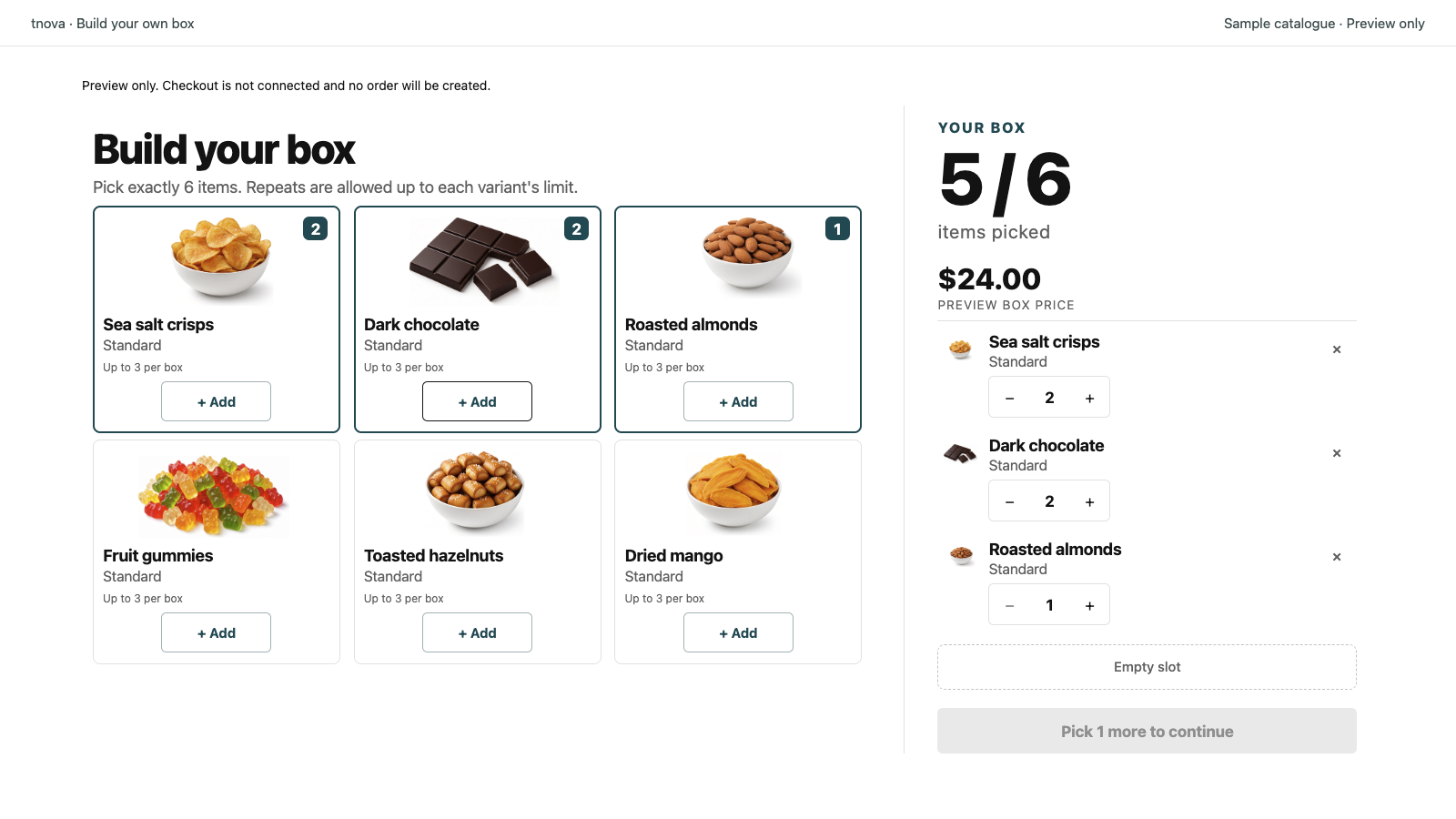
Try the sample picker with fictional products. It creates no cart or order.
Try the box builder