A build your own tea box on Shopify is a fixed-price mix-and-match offer: you choose which teas and accessories are eligible, how many units fill the box, and one box price; shoppers pick within those rules. Tea merchants succeed when loose leaf, bags and accessories share a clear unit story, the worst-case pack still ships, and labeling stays a merchant responsibility outside the picker. This guide covers assortment, unit sizing, pricing, holiday inventory and shipping weight notes—not food-safety certification.
tnova: Build Your Own Box is a Shopify app for fixed-price, shopper-picked gift and tea boxes. It is currently in Shopify App Store review, so public installation is not available yet. Online Store only; no POS.
Why a build your own tea box fits mix-and-match
Tea shoppers already think in picks: green versus black, herbal versus oolong, loose leaf versus bags, a seasonal blend or a house staple, maybe a small infuser as part of the gift. A locked sampler kit cannot capture that preference. A mix and match tea box can—if every candidate fits the same physical unit story and the packed weight stays predictable.
Treat tea as a distinct assortment from coffee, snacks or candy. Sealed loose-leaf pouches, tea bags, sachets and small accessories create different packing patterns than coffee bags or confectionery. Keep this offer focused on tea so the gift story stays clear. For a coffee-focused walkthrough, see build your own coffee box on Shopify. For a snack-focused walkthrough, see build your own snack box on Shopify.
Building a tea candidate list
Curate first. Do not dump every tea SKU into the picker.
Keep a coherent tea mix
Aim for a pool that still feels like one tea gift when every slot is different. A practical mix often includes:
- Loose-leaf pouches or tins in a comparable weight and volume band
- Tea bags or sachets only when the pack count and outer size match the same unit story
- Optional seasonal or limited blends that fit the same box size and weight band
- A house blend or everyday option so not every pick is a premium single origin
- Accessories (infusers, spoons, strainers) only when they are small enough to share the box and you treat them as units with explicit rules
Exclude items that break the pack or the story: oversized gift tins, ceramic teapots that belong in a different offer, open bulk bins, or accessories that dwarf the tea candidates. Follow labeling rules in your jurisdiction separately; the picker does not replace ingredient disclosures.
Define what one “unit” means
Tea assortments fail when one “item unit” means a 50g loose-leaf pouch and another means a 20-bag carton sold as “one pack” without a shared size band. Decide a unit convention before you set required counts:
| Unit style | Works well when | Watch for |
|---|---|---|
| One sealed loose-leaf pouch/tin = 1 unit | Pouches or tins of similar weight and volume across blends | Mixing 25g sample pouches with 100g retail tins in the same box |
| One tea-bag / sachet pack = 1 unit | Packs with a similar bag count and outer size | Mixing 10-bag sleeves with 50-bag cartons |
| One small accessory = 1 unit | Infusers or spoons that fit beside tea candidates | Ceramic or glass pieces that change packing and break risk |
Publish the convention on the product page. Prefer one primary convention per tea gift box Shopify offer. If you include accessories, state how many accessory slots are allowed so shoppers cannot fill the whole box with hardware.
Cap repeats and plan stock
Per-variant limits stop one hyped blend or discounted bag pack from filling every slot. Cap accessories separately if they are in the pool—otherwise an infuser can crowd out the tea.
Shopify tracks inventory at the component level. Plan stock against the combinations you allow, not only against a parent box title. Keep a buffer on bestsellers, and stage seasonal blends with a clear end date. Shopify’s Help Center covers inventory and locations (as of 2026-10-31).
Item count and fixed price for tea
Choose a required item count
Pick a count the packing bench can repeat every order. Many tea operators start with a mid-range count inside a 2–12 item-unit band and test packing before they advertise the offer. Use your own pouch and pack sizes. Required count plus per-variant limits keep boxes comparable for packing and shipping.
Price one fixed box
Shoppers should see one box price before they open the picker, not a running sum of tea retail prices. That is a fixed-price custom tea box.
Work from your own unit costs. Identify the highest-cost mix the rules still allow (including any allowed accessory), and set a box price that can absorb that mix after shipping and packaging. See how to calculate the highest allowed cost of a mix-and-match gift box. Do not invent margins or conversion rates.
If you evaluate tnova: Build Your Own Box after installation opens, stated scope includes boxes of 2–12 item units, up to 100 candidate variants per box, default market and currency only, one shared online fulfillment location, and Online Store only (no POS). Pricing on the site is one plan at $19.90 USD per store per month with a 30-day trial when installation opens—no free plan. The price does not rise with box sales. Public installation is not available yet while the app is in review.
Packaging weight, accessories and holiday inventory
Treat weight, volume and accessory mix as operational constraints before you advertise the offer.
Test the worst-case mix
Build a few worst-case packs: all denser loose-leaf tins, a mix that maxes out pouch height, a mix that takes the maximum allowed accessories. Confirm the box still closes and the packed weight still fits your shipping rates. Loose leaf versus bag packs affect density; metal or ceramic accessories change weight and break risk—test those if they are candidates. Freshness windows are merchant decisions. This article does not prescribe food-safety certification.
Enter accurate product weights in Shopify so checkout rates stay honest. Shopify’s Help Center explains shipment packaging and weights (as of 2026-10-31). Weigh your own candidates—do not invent numbers here.
Packing slips and fulfillment
Each paid order should name the exact tea and accessory variants. Packers need component lines, not only a parent box title. Walk one full order from picker through packing slip before paid traffic. This section does not cover food labeling, allergens, shelf life or certification—follow your jurisdiction.
Stage holidays and BFCM early
Tea gift demand clusters around holidays and Peak Week. Add seasonal candidates only when stock, packaging and shipping windows are ready. Publish in draft, run packing tests, then open paid traffic with lead time. State the last order date that still aims for holiday delivery. A broader prep sequence is in BFCM gift box timeline.
Product page copy and pre-publish checklist
State the rules before shoppers start picking: what the box is, how many item units belong in it and what one unit means, the curated tea list, whether accessories are allowed and how many, any per-variant limit, and that the price is for the completed box. Do not invent stats. Do not promise features you do not ship (gift messages, scheduled launches, POS). Do not claim certification you do not hold.
| Check | Why it matters |
|---|---|
| Candidate tea pool | Coherent tea mix; packable; not the whole catalog |
| Unit convention | Loose leaf vs bag pack vs accessory is clear |
| Accessory rules | Caps prevent hardware from filling the box |
| Per-variant limits | Stops one SKU from dominating every box |
| Required item count | Boxes stay comparable for packing and shipping |
| Fixed box price | Shoppers see one amount before they pick |
| Cost ceiling | Highest allowed mix still fits your price |
| Component stock buffer | Bestsellers and seasonal blends cover allowed mixes |
| Packaging weight | Worst-case mix still closes and ships |
| Freshness / best-by windows | Merchant-owned cutoffs match what you can fulfill |
| Holiday cutoffs | Order dates match fulfillment capacity |
| Theme / cart test | Picker through add-to-cart on your live theme |
| Test order | One full order from picker to packed box |
| Labeling / origins | Merchant-owned disclosures outside the picker |
Theme and cart behaviour varies. If you mention a cart drawer, verify it on that theme first. tnova’s cart drawer (Drawer mode) has been QA-verified on Dawn only—not on every theme.
FAQ
How is a tea box different from a coffee or snack box?
A tea box focuses on sealed tea candidates: loose-leaf pouches or tins, tea bags or sachets, and optionally small accessories with clear unit and size rules. Coffee boxes centre on bean or ground bags; snack boxes mix pantry items with different packing patterns. Keep tea candidates in one coherent gift story so packing weight and shopper expectations stay predictable.
Can accessories sit in the same tea gift box?
Yes, if they are small enough to pack with the tea and you define how many accessory units are allowed. Cap accessories so shoppers cannot fill every slot with hardware. Test break risk and weight when metal, ceramic or glass pieces are candidates. Large teaware usually belongs in a separate offer.
How many units should a tea gift box include?
Choose a required item count your packaging and packing bench can repeat every order. Many tea operators start in a mid-range band inside 2–12 item units and adjust after a packing test. The right count is the one that still feels like a full tea gift without breaking weight, volume or picker time.
Who handles labeling, allergens and freshness claims?
The merchant. This guide covers assortment, unit sizing, fixed pricing, packing and storefront copy for a build your own tea box. It does not cover food labeling, allergen rules, shelf life, health claims or food-safety certification. Follow the requirements that apply in your jurisdiction, and only publish freshness windows you can fulfill.
Is tnova available to install for a tea gift box Shopify offer?
Not yet. tnova: Build Your Own Box is in Shopify App Store review. Public installation is not available, and this article does not include an install link. When installation opens, pricing on the site is one plan at $19.90 USD per store per month with a 30-day trial—no free plan. Scope is Online Store only.
See a gift box in action
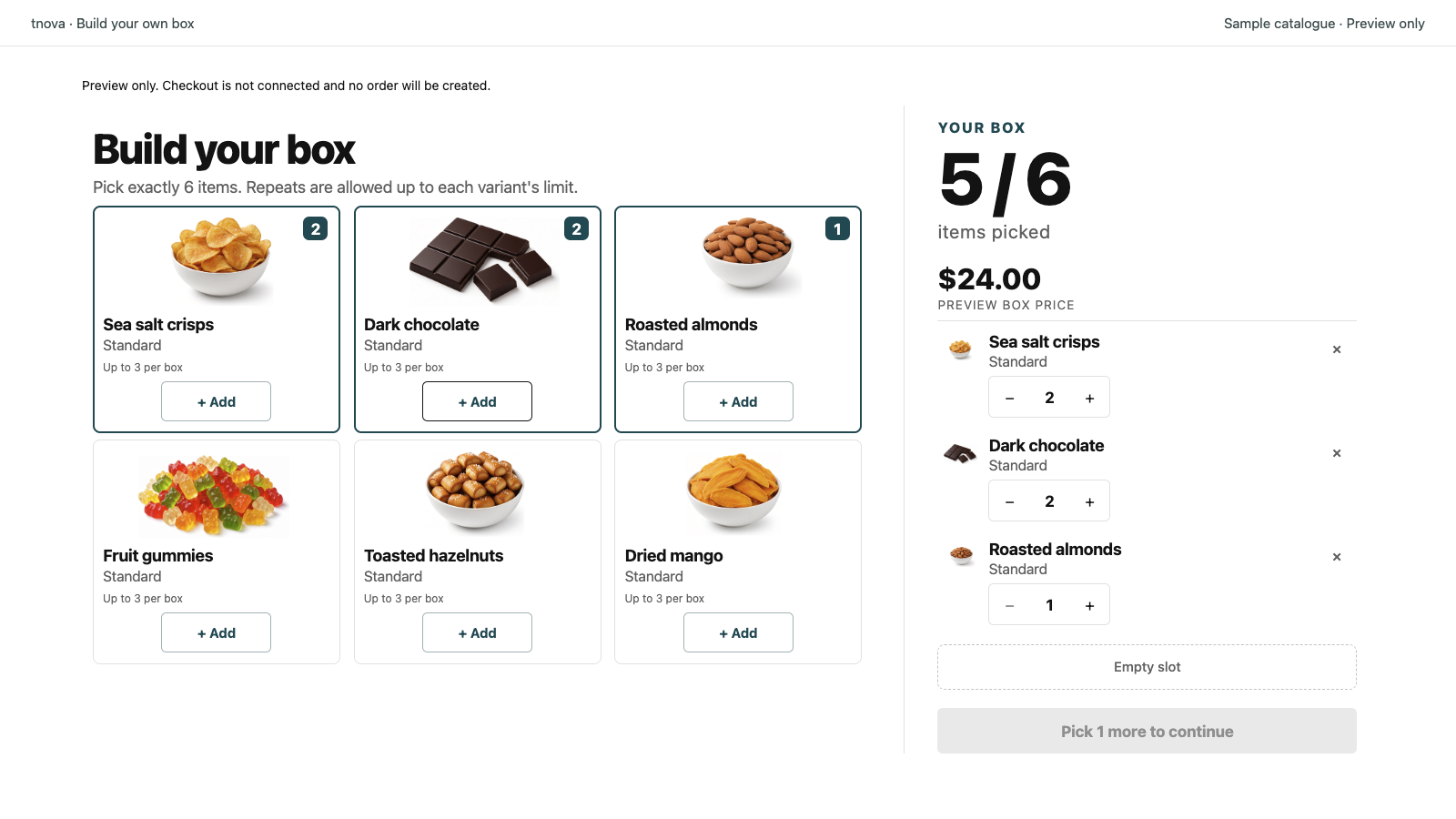
Try the sample picker with fictional products. It creates no cart or order.
Try the box builder